We can't find the internet
Attempting to reconnect
Something went wrong!
Hang in there while we get back on track

Experienced Boaters
Make Better Brokers.
Call us today and see for yourself.


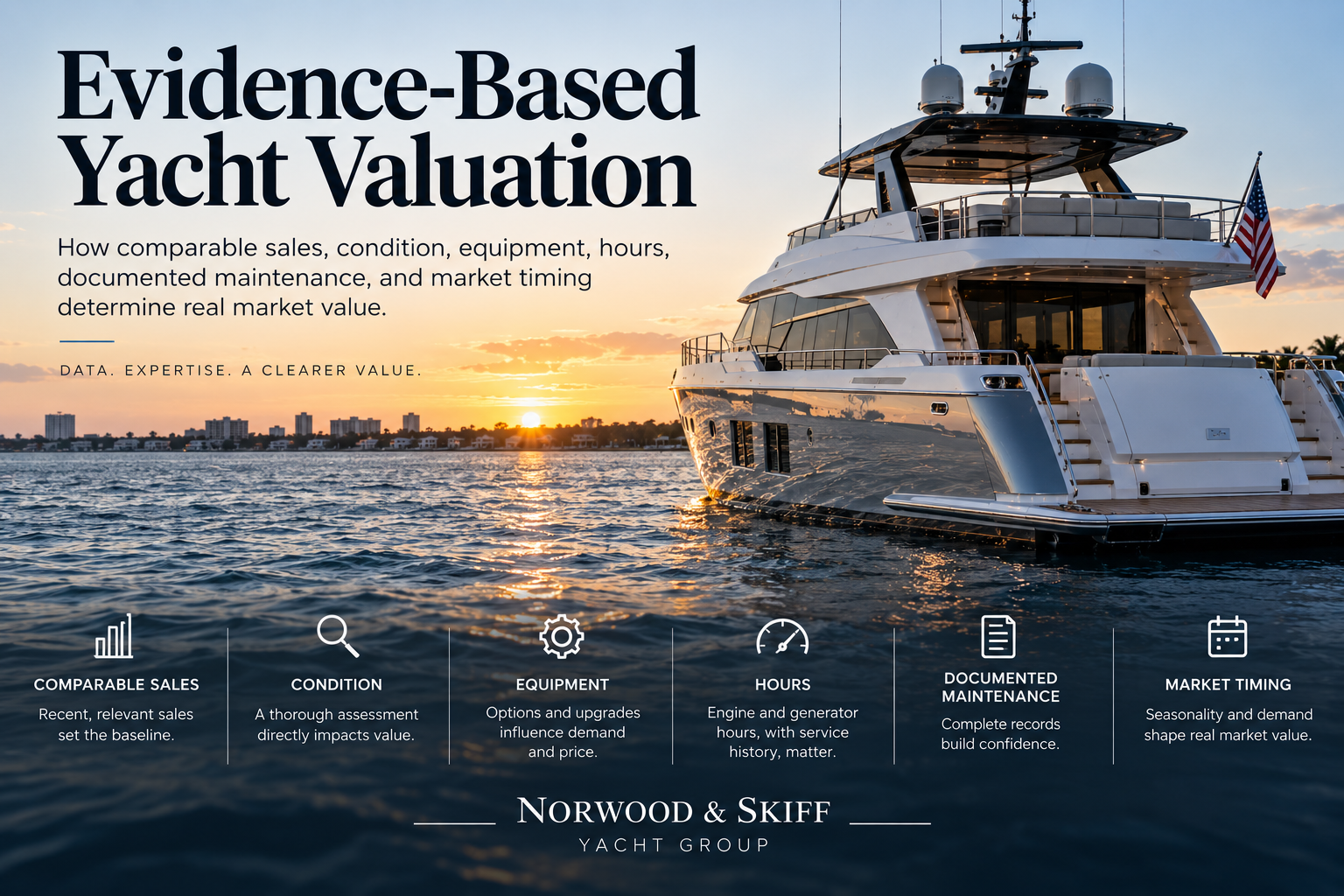
Evidence-Based Yacht Valuation: How a Captain-Broker Finds Real Market Value
Pricing a yacht—or deciding what to offer—is not guesswork and it’s not about what a listing “asks.” Real market value is a function of evidence: comparable sales, condition, equipment, hours, documented maintenance, and timing in the market.
For Southwest Florida owners and buyers, that evidence needs to be interpreted through local realities: canal depth in Cape Coral, bridge clearance in Fort Myers, marina options in Naples, hurricane risk, insurance constraints, and migration of inventory between northern and Florida markets.
At Norwood & Skiff Yacht Group, we approach valuation the way a good captain approaches a tight inlet: carefully, with reference points, and with a plan for when to back out.
Below is how an experienced captain-broker builds an evidence-based view of value—for sellers who want realistic pricing and for buyers who want negotiating clarity.
Step 1: Start with Comparable Sales, Not Just Asking Prices
A “comparable sale” (or “comp”) is a recent closed transaction on a yacht similar to the one you’re buying or selling. This is the starting point for any serious valuation.
We look for:
- Same or similar manufacturer and model
- Close model years (usually within 3–5 years)
- Similar engine package and propulsion (shaft, pod, outboard)
- Similar size range and layout (3-cabin vs 2-cabin, flybridge vs express)
- Similar geographic markets (Florida vs northern U.S. vs Caribbean)
Why closed sales matter more than asking prices:
- Asking prices reflect seller expectations, emotion, or “let’s see what happens” strategies.
- Closed prices reflect what a qualified buyer actually paid after survey, sea trial, and negotiation.
- In many segments, the spread between asking and selling price can be 5–15% or more, depending on condition and motivation.
For Southwest Florida yachts, we also ask:
- Did that comp boat live in saltwater or spend time in freshwater up north?
- Was it stored on a lift in Cape Coral or a wet slip in Naples?
- Did it have hurricane history or insurance claims?
Those details influence how strongly a comparable sale applies to your situation.
Step 2: Adjust for Condition and Hours—The “Real Story” of the Boat
Two similar models can have very different values if one has been actively maintained and the other has deferred work.
We assess:
Overall condition
- Hull and topsides: gelcoat, paint, corrosion, prior repairs
- Interior: wear, leaks, odors, soft spots, fit and finish
- Machinery spaces: cleanliness, access, signs of leaks or shortcuts
Engine and generator hours
Hours by themselves don’t tell the whole story. A high-hour engine with strong service history can be a better risk than a low-hour engine with long idle periods.
We ask:
- Are hours appropriate for age? (For example, 100–150 hours per year on a cruiser is common.)
- Have major services been done on schedule (aftercoolers, heat exchangers, valve adjustments, pod services)?
- Are hours balanced across engines and generators?
Service history
Documented maintenance often separates “asking” price from “getting” price. A vessel with comprehensive records can justify a stronger value than a newer, poorly documented boat.
We give weight to:
- Logbook entries, invoices, and yard records
- Evidence of recurring professional care versus sporadic repairs
- Recent major services that the next owner won’t need to repeat immediately
A well-maintained yacht with strong records can be a better purchase than a newer yacht with deferred maintenance—something an experienced captain-broker will emphasize even when it makes a listing less “flashy” on paper.
Step 3: Equipment, Upgrades, and What Actually Matters
Not all upgrades are created equal. Some meaningfully affect value and marketability; others are cosmetic or taste-specific.
Equipment and features that typically support value:
- Updated navigation and electronics (modern multi-function displays, radar, AIS, autopilot)
- Stabilization (gyro or fins) on larger motor yachts
- Upgraded air conditioning and chiller systems—critical in Southwest Florida heat
- Recent canvas/enclosures, upholstery, and soft goods
- Bow and stern thrusters or joystick docking systems
- Watermakers and upgraded inverter/charging systems for cruisers and Great Loop yachts
- Tender and davit/lift systems in good condition
Items that have less impact on market value:
- Outdated electronics “upgrades” that are now at end of life
- Entertainment systems and décor that are highly personal
- Minor cosmetic accessories or décor packages
A captain-broker will consider not only what’s installed, but how it’s installed. Clean, professional wiring and proper integration tell you more about the vessel’s care than brand names alone.
Step 4: Market Timing and Local Southwest Florida Realities
Market value moves with supply, demand, and broader conditions. Timing can shift value by tens of thousands of dollars on mid-size yachts and far more at the larger end.
Key timing factors:
- Seasonal demand: Florida winters bring more buyers to Cape Coral, Fort Myers, Naples, and Marco Island. Late fall and winter often see stronger showing activity.
- Inventory migration: As northern boats come south, local buyers may gain more choices—or more competition if you’re a seller.
- Hurricane season: Buyers may demand price concessions if a boat just rode out a storm or needs additional storm-prep investments.
- Interest rates and insurance: Financing cost and insurability directly affect what buyers can realistically pay.
Local suitability in Southwest Florida also affects value:
- Draft and air draft relative to Cape Coral canals, bridges in Fort Myers, or access around Sanibel and Pine Island
- Ability to get to open water from canal homes without excessive bridge or shallow-water issues
- Practicality for Sanibel/Captiva day trips, Naples and Marco Island overnights, or Bahamas and Great Loop ambitions
A vessel that’s an excellent match for Southwest Florida cruising can be worth more here than the same model marketed in a region where it’s less suitable—and the opposite is also true.
Step 5: Turning Evidence into a Strategy—for Sellers and Buyers
Once the evidence is gathered, the real work is interpretation and judgment.
For sellers: realistic pricing that protects your net
We work with sellers to:
- Build a pricing range based on comparable sales adjusted for condition, equipment, hours, and location
- Position the yacht against competing inventory (not just similar models, but similar use cases)
- Decide whether to target faster sale or higher price within a reasonable time frame
- Prepare the boat, records, and presentation so that the survey and sea trial support your asking price, rather than undermine it
The goal isn’t to list high and “see what happens.” Overpricing typically leads to longer time on market, more low offers, and a lower eventual net.
For buyers: negotiating clarity and risk-adjusted value
For buyers, evidence-based valuation gives you:
- A defensible offer strategy with clear rationale
- A framework for negotiating after survey and sea trial if material findings arise
- An understanding of total ownership cost, not just initial price (maintenance, dockage, insurance, fuel, refit needs)
- The confidence to walk away when a yacht’s risk-adjusted value doesn’t justify the number
Sometimes the right advice is: “This looks great on the listing, but the evidence says pass.” That’s where operating experience and thousands of transactions matter more than salesmanship.
Why Work with a Captain-Broker for Valuation?
A yacht is not just an asset; it’s machinery, systems, and ongoing obligation. Interpreting valuation data without understanding how these vessels operate can lead to expensive mistakes.
A captain-broker brings:
- Firsthand operating experience across a range of yachts and propulsion systems
- Technical judgment on condition that goes beyond cosmetics
- Familiarity with surveys, sea trials, and how findings impact value and risk
- Local Southwest Florida knowledge of canals, depth, bridges, marinas, service options, and storm planning
- The professional distance to recommend walking away when the evidence doesn’t support the deal
Evidence-based valuation is about aligning price with reality—for both seller and buyer—so the transaction you complete is one you’re glad you did years later.
If you’re considering selling your yacht in Southwest Florida or evaluating a yacht to purchase, Norwood & Skiff’s captain-brokers can help you understand its real, evidence-based market value.
Contact our team in Cape Coral, Fort Myers, Naples, or the surrounding area to discuss your yacht, your goals, and a clear valuation strategy.