We can't find the internet
Attempting to reconnect
Something went wrong!
Hang in there while we get back on track

Experienced Boaters
Make Better Brokers.
Call us today and see for yourself.

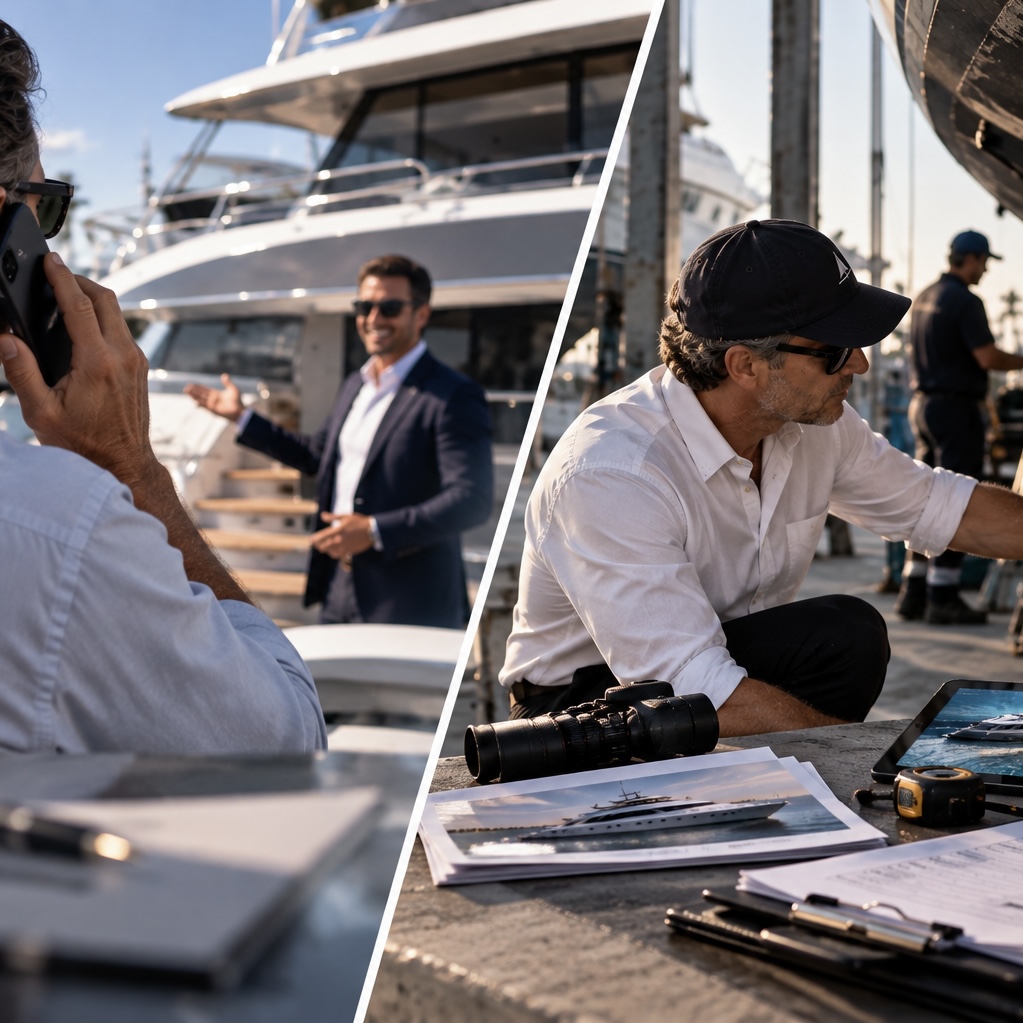
Independent Buyer Representation vs. Calling the Listing Broker
How Captain-Brokers Change the Outcome for Southwest Florida Yacht Buyers
When you see an attractive yacht online in Cape Coral, Fort Myers, or Naples, the easiest next step is to click “contact listing broker.” Many buyers do exactly that—often without realizing they’ve just called the seller’s representative.
For a transaction involving hundreds of thousands (or millions) of dollars, that distinction matters.
At Norwood & Skiff Yacht Group, we represent buyers and sellers—but rarely both sides of the same transaction. Our team is built around captain-brokers and technical professionals whose job is to help you buy the right yacht, on the right terms, or walk away when you should.
This article explains:
- Why the listing broker’s role is fundamentally different from a buyer’s broker
- How conflicts of interest can affect advice, pricing, and negotiations
- What an experienced captain-broker actually does during search, negotiation, survey, and sea trial
- Why this matters specifically in Southwest Florida from Cape Coral to Naples
Listing Broker vs. Buyer’s Broker: Who Do They Work For?
Listing broker: The seller’s representative. They:
- Advise the seller on pricing and positioning
- Market the yacht and generate inquiries
- Try to secure the strongest overall outcome for the seller
Buyer’s broker / independent buyer representation: Your representative. They:
- Help you define what you actually need from a yacht
- Evaluate multiple options (including boats they do not list)
- Challenge asking prices using comparable sales and condition
- Negotiate on your behalf, not to “save the deal” at all costs
Both roles are valid. The problem arises when a buyer assumes that “calling the name on the listing” means they now have representation. In most cases, you don’t. You’ve contacted the seller’s broker.
In complex, high-value transactions, sophisticated businesspeople would not rely on the seller’s real-estate agent for their only advice. Yachts are no different—except they add machinery, systems, seaworthiness, and operating risk.
Where Conflicts of Interest Show Up
When one broker attempts to “cover both sides,” interests can blur in ways buyers do not always see.
Common pressure points:
-
Pricing and valuation
The listing broker helped set the asking price. It is difficult for that same broker to aggressively argue it is too high, or that market evidence justifies a significantly lower offer. -
What not to buy
Strong buyer representation sometimes means saying, “This is the wrong yacht for how you will actually use it,” even after weeks of work. That is easier when your compensation is not tied to a single listing. -
Survey and repair negotiations
After survey and sea trial, someone has to press for realistic concessions or walk-away rights. A dual agent often feels pressure to “keep the deal together,” even when issues justify a reset. -
Disclosure gaps
A listing broker is bound by what they know and what the seller tells them. They are not inspecting the yacht as your technical advocate. A captain-broker representing a buyer is actively trying to uncover what the listing doesn’t reveal.
This is why Norwood & Skiff puts so much weight on independent buyer representation and captain-level experience.
What a Captain-Broker Actually Does for a Buyer
Many buyers underestimate how much work should happen before, during, and after an offer. Here’s how a captain-broker from Norwood & Skiff changes the process.
1. Clarifying Intended Use and Southwest Florida Constraints
A yacht that looks right on paper may be wrong for how you plan to use it—or where you plan to keep it.
We start with clear, practical questions:
- Where will the yacht live: Cape Coral canal, Fort Myers riverfront, Naples marina, Marco Island dock?
- What water depths, bridge clearances, canal widths, and turning room will you face?
- Are you planning day boating to Sanibel and Captiva, overnights to Boca Grande and Cayo Costa, or extended Bahamas and Great Loop cruising?
- Who will operate the yacht: experienced owner-operator, part-time captain, or full-time crew?
From there, we narrow down hull types, draft, air draft, propulsion (shafts vs. pods vs. outboards), and layout. A technically experienced broker can tell you why a particular 50’ yacht might work in Naples but create problems in a Cape Coral canal with shallow low-tide depths or fixed bridge clearance.
2. Market Evidence and Realistic Yacht Valuation
Asking price and value are not the same thing. We look at:
- Recent comparable sales (size, year, brand, hours, equipment)
- Documented maintenance and refit history
- Engine type, hours, and known lifecycle issues
- Pods, stabilizers, generators, and electronics condition
- Regional factors: Florida exposure, dock rash, hurricane history, service availability
We explain valuation plainly:
- What similar yachts have actually sold for
- How condition and records shift value up or down
- Where an aggressive but realistic offer range likely sits
This keeps you from overpaying for a clean listing—or walking away from a well-maintained yacht that is actually priced fairly.
Search and Shortlist: Looking Beyond the Obvious
Independent buyer representation means we are not limited to our own listings.
We:
- Screen yachts across multiple brokerages and platforms
- Eliminate poor fits early (draft too deep, limited bridge clearance, no realistic service support, problematic brands/engines in this region)
- Use our working knowledge of builders such as Azimut, Beneteau, Boston Whaler, Hatteras, Ocean Alexander, Sea Ray, etc., to anticipate common issues
The goal is not to show you the most boats. It is to quickly focus on the few that make sense for your use, dockage, and budget.
Offer Strategy, Contract Terms, and Risk Control
Once you choose a target yacht, the captain-broker’s role becomes part tactician, part risk manager.
We help you:
- Structure an offer that reflects market evidence, not emotion
-
Include clear contingencies (conditions that must be satisfied before closing), such as:
- Satisfactory survey and sea trial
- Acceptable engine and systems inspection
- Insurance and financing approval
- Define realistic timelines and logistics for inspections in Southwest Florida (haul-out yards, mechanics, surveyors, travel, and hurricane-season timing)
We also explain, in plain language:
- What happens to your deposit at each step
- When you can walk away and under what circumstances
- Which survey findings justify price negotiations versus which are normal for age
Survey and Sea Trial: Translating Technical Findings into Decisions
The survey (professional inspection) and sea trial (on-water test) are where experienced judgment is critical.
A captain-broker will:
- Help you select appropriate surveyors and engine technicians
- Be physically present, when engaged to do so, to see how the yacht behaves underway—not just read a report later
-
Ask the hard questions about:
- Engine condition, compression, and service history
- Pod or shaft alignment, vibration, and performance under load
- Generator, air conditioning, electrical, and electronics
- Evidence of previous damage, moisture, or structural issues
Then we translate findings into decisions:
- Which items are normal “used yacht” wear versus red flags
- What a realistic repair or refit budget looks like in Southwest Florida
-
Whether to:
- Proceed as planned
- Renegotiate based on objective findings
- Walk away and preserve your capital for a better yacht
The value is not just identifying problems—it is knowing which problems still make sense at the right price and which fundamentally change the risk profile.
Southwest Florida Realities: Ownership Costs and Suitability
For buyers in Cape Coral, Fort Myers, Naples, Marco Island, Punta Gorda, and Charlotte Harbor, local context matters.
Your captain-broker will factor in:
- Dockage and access: Depth at your slip, seasonal water levels, canal width, pilings, and wind exposure
- Heat, humidity, and systems load: Air conditioning capacity, generator hours, and realistic service intervals
- Hurricane planning: Tie-up strategies, haul-out options, insurance requirements, and storm preparation costs
- Service ecosystem: Availability of qualified mechanics, yards, and specialists for your chosen brand and propulsion
We model ownership costs beyond the purchase price: insurance ranges, annual maintenance, bottom work, expected upgrades, and the cost of “catching up” on deferred service.
When the Right Decision Is Not to Buy
Sometimes, the most valuable outcome of disciplined due diligence is choosing not to proceed.
Experienced brokers who have also been captains, yacht managers, and mechanics know when to say:
- “This yacht will be difficult to live with in your canal.”
- “The survey turned up enough structural and machinery risk that, even with a discount, this is not the right platform.”
- “You are paying a premium for a layout and equipment you will not use.”
That is the difference between simple representation and experienced judgment.
Considering a Yacht in Southwest Florida?
If you’re comparing options from Cape Coral to Naples and want an independent captain-broker to help you search, evaluate, negotiate, and manage survey and sea trial, Norwood & Skiff is built for that role.
Contact Norwood & Skiff Yacht Group to discuss your plans confidentially and see how experienced judgment can change the outcome of your next yacht purchase.