We can't find the internet
Attempting to reconnect
Something went wrong!
Hang in there while we get back on track

Experienced Boaters
Make Better Brokers.
Call us today and see for yourself.

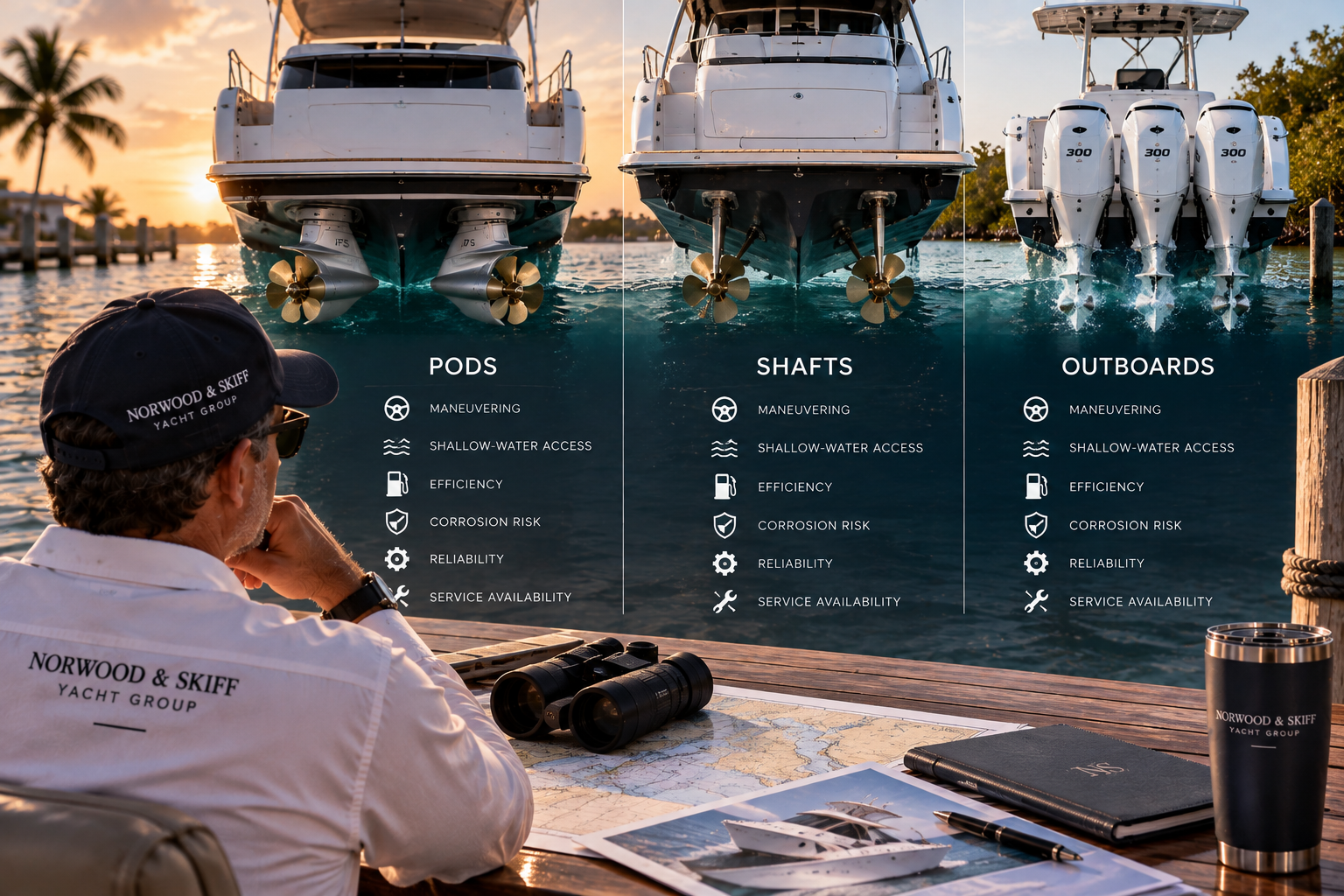
Pods, Shafts, or Outboards for Southwest Florida? A Practical Guide for Real-World Use
Choosing between pods, straight shafts, and outboards in Southwest Florida is not a lifestyle decision. It’s a question of how you actually use your yacht in Cape Coral, Fort Myers, Naples, Marco Island, Punta Gorda, and the surrounding waters—and what you’re willing to own, maintain, and service over time.
At Norwood & Skiff Yacht Group, our brokers have run all three systems in the same waters our clients run every week: shallow canals, tight marinas, Charlotte Harbor chop, and Gulf runs to Sanibel, Captiva, Cayo Costa, Boca Grande, the Keys, and the Bahamas. This is a candid framework to help you—and your buyer’s broker—decide what makes sense.
Start With How You Really Use the Boat
Before debating pods vs shafts vs outboards, get clear on:
- Where you keep the boat: Cape Coral canals? Marco Island dock? Dry stack? Marina in Fort Myers or Naples?
- How often you move it: Weekend day-boating vs seasonal cruising vs Great Loop planning.
- How you handle the boat: Single-handed? Spouse and family? Hired captain?
- Where you actually run: 4–7 ft canal depths vs ICW vs Gulf crossings vs Bahamas runs.
The right drive system for a shallow Cape Coral canal boater is not automatically the right answer for a 60–70’ motoryacht doing extended cruising.
Pods (Zeus, Volvo IPS, etc.)
Pod drives place the propulsion unit under the hull, typically with forward-facing props, and are joystick-controlled from the factory.
Strengths in Southwest Florida
-
Excellent maneuvering:
Pods with joystick make tight Cape Coral and Punta Gorda canals, stern-in slips, and windy Naples marinas significantly easier to handle, especially for couples. -
Fuel efficiency and speed:
Efficient at cruise when properly propped and loaded; often faster at a given fuel burn than comparable shaft boats. -
Quiet and smooth:
Less vibration and cabin noise compared with many shaft boats, valuable on longer Gulf or Keys runs.
Tradeoffs and Risks
-
Draft and vulnerability:
Pods typically sit lower than shafts. In shallow canals, bars at inlets, and skinny water around Sanibel, Captiva, and Pine Island, a mistake can be expensive. Grounding a pod often means real damage. -
Corrosion and complexity:
More underwater metal, more seals, more electronics. Southwest Florida’s warm, salty, shallow water is hard on any system—pods demand disciplined anode replacement, bottom work, and proper bonding. -
Service availability:
Not every yard is efficient with pods, and not every market has equal support. Naples and Fort Lauderdale are generally strong; some smaller Gulf Coast marinas less so. Local pod expertise should be a decision factor.
Who Pods Fit Best
-
Owners in the 40–65 ft range who:
- Value joystick control and easy close-quarters handling.
- Run in mostly known depths and marked channels.
- Have reliable local pod service and are willing to budget for it.
- Care about efficiency and performance more than ultimate simplicity.
If you run very shallow canals or routinely “feel your way” into skinny spots, pods may be more risk than they’re worth.
Straight Shafts
Straight shafts connect the engines to fixed shafts and props under the hull—older technology, but proven and widely understood.
Strengths in Southwest Florida
-
Durability and survivability:
When (not if) you bump a soft bottom or find a bar outside a pass, shafts are usually more forgiving. Props and shafts can be repaired or replaced at most local yards. -
Simplicity and service network:
Straight shafts with conventional inboards are well-known to mechanics from Cape Coral to Jacksonville. Parts and know-how are rarely a problem. -
Predictable handling offshore:
In Gulf chop and open-water runs, many owners prefer the predictable tracking and seakeeping of a well-designed shaft boat.
Tradeoffs
-
Maneuverability without joystick:
Traditional twin inboards can be handled precisely with practice, but it’s a skill. For new or seasonal operators, stern-in docking in tight Lee County canals can be intimidating. -
Draft:
Larger shaft boats often draw more water than comparable pod or outboard boats. For some Cape Coral canal homes, that can be the deciding factor. -
Efficiency and speed:
Generally less efficient than pods at the same speed. However, differences may be smaller than advertised once real-world loading and conditions are considered.
Joysticks on Shaft Boats
Many builders and retrofitters now add joystick systems to shaft boats (using bow and stern thrusters and engine control integration).
-
Pros:
- Pod-like maneuverability for docking without changing the fundamental drive system.
- Retains shaft durability and simpler underwater gear.
-
Cons:
- Adds cost, electronics, and additional gear (especially a stern thruster) to maintain.
- Still requires conventional seamanship offshore and underway.
Who Shafts Fit Best
-
Owners of 38–80+ ft motoryachts and convertibles who:
- Are serious cruisers or plan Great Loop, Keys, or Bahamas runs.
- Prioritize robust gear and serviceability over absolute ease of docking.
- Have reliable yard relationships and value long-term ownership.
- Are willing to invest in training or joystick/thrusters to ease marina work.
For heavier yachts in the 50–80 ft range, straight shafts remain the default for a reason.
Outboards
Modern outboards have moved far beyond fishing boats; triple and quad setups now push 35–50 ft center consoles and even some cabin boats.
Strengths in Southwest Florida
-
Shallow-water access:
Trimmable drives are ideal for skinny canals, Pine Island Sound flats edges, and sandbars around Cayo Costa and North Captiva. -
Service and parts availability:
Yamaha, Mercury, and Suzuki support is extensive in Cape Coral, Fort Myers, Naples, Marco Island, and along the Gulf Coast. -
High speed and response:
Ideal for owners who like to run fast between spots or make quick crossings in good weather.
Tradeoffs
-
Exposure and corrosion:
Everything lives outside. In Florida heat, UV, and salt, that means diligent flushing, anodes, and scheduled replacement. Neglected outboards in Southwest Florida can become an expensive lesson. -
Noise and fuel at cruise:
Quieter and more efficient than old generations, but on larger multi-engine boats, fuel burn can be substantial at higher cruise speeds. -
Space and aesthetics:
On some cabin boats, outboards can complicate swim platform access and boarding and change how the boat is used.
Who Outboards Fit Best
-
Owners of 35–45 ft center consoles and outboard-powered express or dayboats who:
- Run a lot in shallow water and inlets.
- Want local dealer support and fast turnaround on service.
- Prefer speed and day-use flexibility over large interior volume.
For many Cape Coral and Fort Myers canal boaters who primarily run to the islands and back, a well-maintained outboard setup is often the most practical answer.
Matching Drive Type to Your Southwest Florida Reality
When we help buyers evaluate yachts for sale in Cape Coral, Fort Myers, Naples, Marco Island, and surrounding areas, we focus on:
-
Maneuvering needs:
- Do you routinely dock in tight canals or windy marinas?
- Will you ever dock alone or with an inexperienced crew?
-
Shallow-water and canal constraints:
- Depth at your dock, canal width, turning basin size, and bridge clearance.
- Tides and seasonal water levels in your specific neighborhood.
-
Service ecosystem:
- What brands and systems are strongly supported within a practical radius?
- Which local yards and dealers have real pod, shaft, or outboard expertise?
-
Ownership costs and risk:
- Pods: higher repair exposure and insurance considerations after groundings.
- Shafts: lower complexity but potential larger haul-out jobs.
- Outboards: periodic repowers and constant corrosion management.
A “deal” on the wrong drive system for your dock, your waters, and your service network is not a deal.
Get Candid, Experience-Based Advice Before You Commit
Drive type is just one part of choosing the right yacht for Southwest Florida, but it’s a major one—and it’s hard to fix after the fact.
Norwood & Skiff’s captain-brokers combine buyer representation, technical evaluation, and local knowledge of Cape Coral, Fort Myers, Naples, Marco Island, Punta Gorda, Sanibel, Captiva, and Charlotte Harbor to help you:
- Select the right drive system and joystick solution for your dock, canals, and cruising plans.
- Evaluate survey findings, corrosion risk, and underwater gear condition.
- Understand real ownership costs, not just asking prices and fuel burn numbers.
If you’re considering a pod, shaft, or outboard yacht in Southwest Florida, speak with a Norwood & Skiff broker before you write the offer. We’ll walk through your intended use, your dock, and your service options—and help you decide which systems truly fit your boating life here.