We can't find the internet
Attempting to reconnect
Something went wrong!
Hang in there while we get back on track

Experienced Boaters
Make Better Brokers.
Call us today and see for yourself.


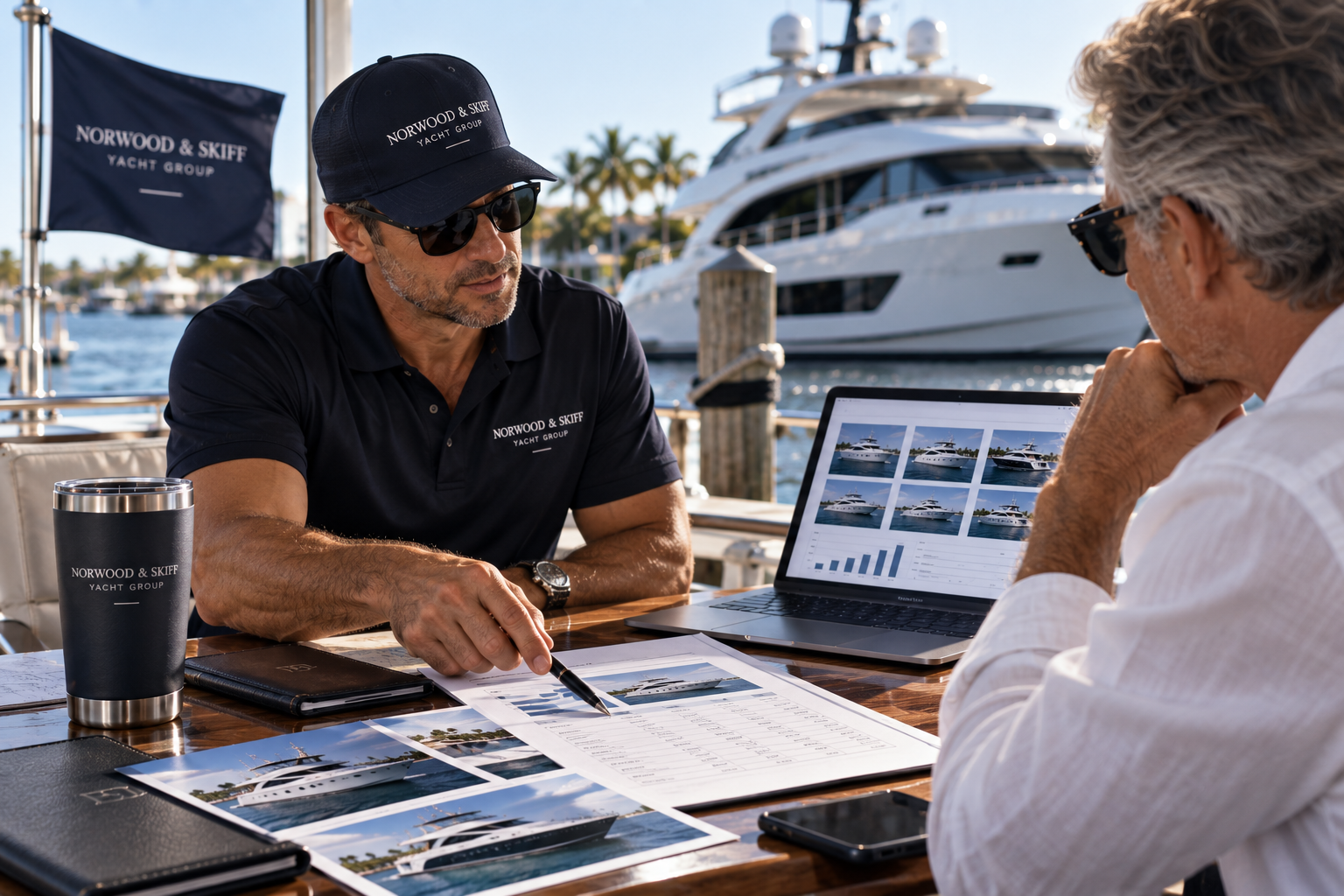
Evidence-Based Yacht Valuation for Sellers in Southwest Florida
When you decide, “It’s time to sell my yacht,” the next question is almost always: “What is it really worth?”
In Southwest Florida markets like Cape Coral, Fort Myers, Naples, Marco Island, Sanibel, Captiva, and Punta Gorda, a realistic, evidence-based valuation is the difference between:
- A yacht that attracts qualified buyers and closes, versus
- A listing that sits, grows stale, and ultimately sells for less than it should
At Norwood & Skiff Yacht Group, we treat valuation as a disciplined process—not a guess and not a number designed simply to win a listing. Here’s how a professional listing broker builds a pricing case that buyers, surveyors, and lenders take seriously, and what to do when the market doesn’t match your target number.
What “Market Value” Really Means in Yacht Brokerage
Market value is not:
- What you paid for the yacht
- What you have invested in upgrades
- What a neighbor says their yacht is worth
- The highest asking price for a similar model online
In brokerage, practical market value is the price at which a qualified buyer is willing to proceed after:
- Reviewing comparable sales
- Evaluating condition and equipment
- Reading surveys and service history
- Securing insurance and financing
A good listing broker’s job is to understand that number before you go to market, then position the yacht in a way that justifies it.
Step 1: Comparable Sales – Your Starting Point, Not the Whole Story
“Comps” (comparable sales) are recent, closed transactions for similar yachts. They are the foundation of any credible valuation.
A professional yacht broker will:
- Pull sold data (not just asking prices) for the same brand, model, size range, and age
- Adjust for equipment, refits, hours, and engine packages
- Filter out outliers—distress sales, storm-damaged boats, or unusually old data
- Focus on sales in similar markets, ideally Florida or the broader Southeast
For a late-model 50–60 ft motor yacht, for example, we may look at:
- 6–12 months of sold comparables for your model and close siblings
- Asking-to-sold price spreads (how much discount buyers achieved)
- Time on market for properly priced vs. overpriced inventory
This analysis gives a realistic value range, not a single magic number. The rest of the valuation work is determining where your yacht falls within that range.
Step 2: Condition – Where Your Yacht Sits Within the Range
Two yachts with the same year, model, and engine package can justify very different prices based on condition. Buyers, surveyors, and lenders all react strongly to what they see during inspection and survey.
We look at:
- Mechanical condition – evidence of proper engine and generator service, cooling system work, aftercoolers, pods, stabilizers, steering, thrusters
- Cosmetic condition – gelcoat, paint, teak, upholstery, soft goods, interior wear
- Systems – air conditioning, electronics, plumbing, electrical systems, batteries, chargers, inverters, helm controls
- Evidence of deferred maintenance – leaks, corrosion, outdated or inoperative systems, moisture issues
In Southwest Florida, heat, UV, and salt accelerate wear. A 2012 yacht that has lived in Cape Coral without consistent care may present more like a 2005 in a northern climate. A well-maintained local yacht with strong records, however, can command a premium above average comps.
Step 3: Equipment and Upgrades – Not Every Dollar Spent Adds a Dollar of Value
Equipment matters, especially for serious Southwest Florida and Bahamas cruising, but upgrades don’t add value dollar-for-dollar.
We factor in:
- High-impact options – stabilizers, joystick docking, upgraded electronics, watermaker, bow and stern thrusters, hardtop vs. canvas, larger generator
- Recent refits – new electronics packages, complete soft-goods refresh, paint jobs, teak replacement, major engine or pod overhauls
- Shallow-draft or Great Loop–friendly features – air draft, bridge clearance, draft, and fuel range that are particularly attractive in this region
We then:
- Separate “value-supporting” upgrades (that help justify the upper end of market value)
- From “owner-preference” customizations (which may have minimal resales impact or, in some cases, narrow the buyer pool)
The goal is to use upgrades to justify a strong—but defendable—ask, not to try to recover every install receipt in the asking price.
Step 4: Documented Maintenance and Service History – Your Best Evidence
For many buyers, a slightly older yacht with excellent, documented maintenance is a better risk than a newer boat with thin records. Lenders and insurers often think the same way.
Strong documentation includes:
- Engine and generator service records with dates and hours
- Invoices for significant work (cooling systems, pods, transmissions, stabilizers)
- Bottom work, running gear, and hull maintenance
- Air conditioning, electrical, and electronics service
- Hurricane plans, haul-out history, and storm repairs (if any), documented properly
When we build your valuation case, we want to be able to say to buyers:
- “Here is the complete service file.”
- “Here is when the last major engine work was completed, by whom, and at what hours.”
- “Here are the invoices that support the condition you see aboard.”
That level of transparency increases buyer confidence, helps survive survey negotiations, and supports a higher, more defensible price.
Step 5: Southwest Florida Market Realities
Local knowledge materially affects value and target-buyers in Cape Coral, Fort Myers, Naples, Marco Island, Punta Gorda, and Charlotte Harbor.
We consider:
- Draft and air draft for Cape Coral canals, bridge clearances, and shallow passes
- Canal width and turning room – whether your yacht is realistic for many local docks
- Dockage and power requirements – 30A vs. 50A/100A, single vs. three-phase
- Hurricane season and insurance – underwriters’ current appetite for Florida exposure
- Seasonality – winter buyer migration, major boat shows, and when northern boats move south
A yacht that is well-suited to Southwest Florida cruising (Sanibel, Captiva, Cayo Costa, Boca Grande, Keys, Bahamas) can attract a stronger pool of qualified buyers—if the listing narrative and pricing communicate that suitability clearly.
When Your Target Number and the Market Don’t Match
It’s normal for sellers to have a number in mind that doesn’t align with market evidence. A good listing broker should show you:
- Sold comparable data and trendlines
- Competing active listings and their time on market
- Adjustments for your condition, equipment, and records
- Likely buyer and lender reactions to various asking-price strategies
From there, you have choices:
-
Price within the evidence-based range
- Attracts more qualified buyers
- Shortens time on market
- Reduces the risk of low offers and failed deals after survey
-
Test the upper edge of the range with a clear timeline
- Start slightly above the core value if justified by condition/equipment
- Set pre-agreed review points (e.g., 30–60 days) for price adjustments
- Watch buyer activity and feedback closely
-
Hold a premium number and accept a longer sale timeline
- Understand you may be waiting for a very specific buyer
- Accept the risk that market conditions could soften while you wait
Our responsibility is to recommend the strategy that maximizes your risk-adjusted value—not just the highest aspirational number.
Why Your Listing Broker’s Valuation Case Matters
Serious buyers, lenders, insurers, and surveyors all evaluate the same evidence:
- Comparable sales
- Condition
- Equipment and upgrades
- Documented maintenance
- Regional suitability and risks
A superficial “price high and see what happens” approach can backfire: extended time on market, price reductions that signal distress, and tougher negotiations after survey.
An experienced, technically informed listing broker builds a valuation case that:
- You understand and believe in
- Buyers see as credible
- Lenders and insurers are comfortable supporting
That is how you attract qualified buyers without leaving money on the table.
If you’re considering selling your yacht in Cape Coral, Fort Myers, Naples, Marco Island, Punta Gorda, or surrounding Southwest Florida markets, Norwood & Skiff can review your vessel, service records, and market comps and give you a candid valuation discussion—not a sales pitch.
Contact Norwood & Skiff Yacht Group to schedule a confidential, evidence-based pricing consultation for your yacht.