We can't find the internet
Attempting to reconnect
Something went wrong!
Hang in there while we get back on track

Experienced Boaters
Make Better Brokers.
Call us today and see for yourself.

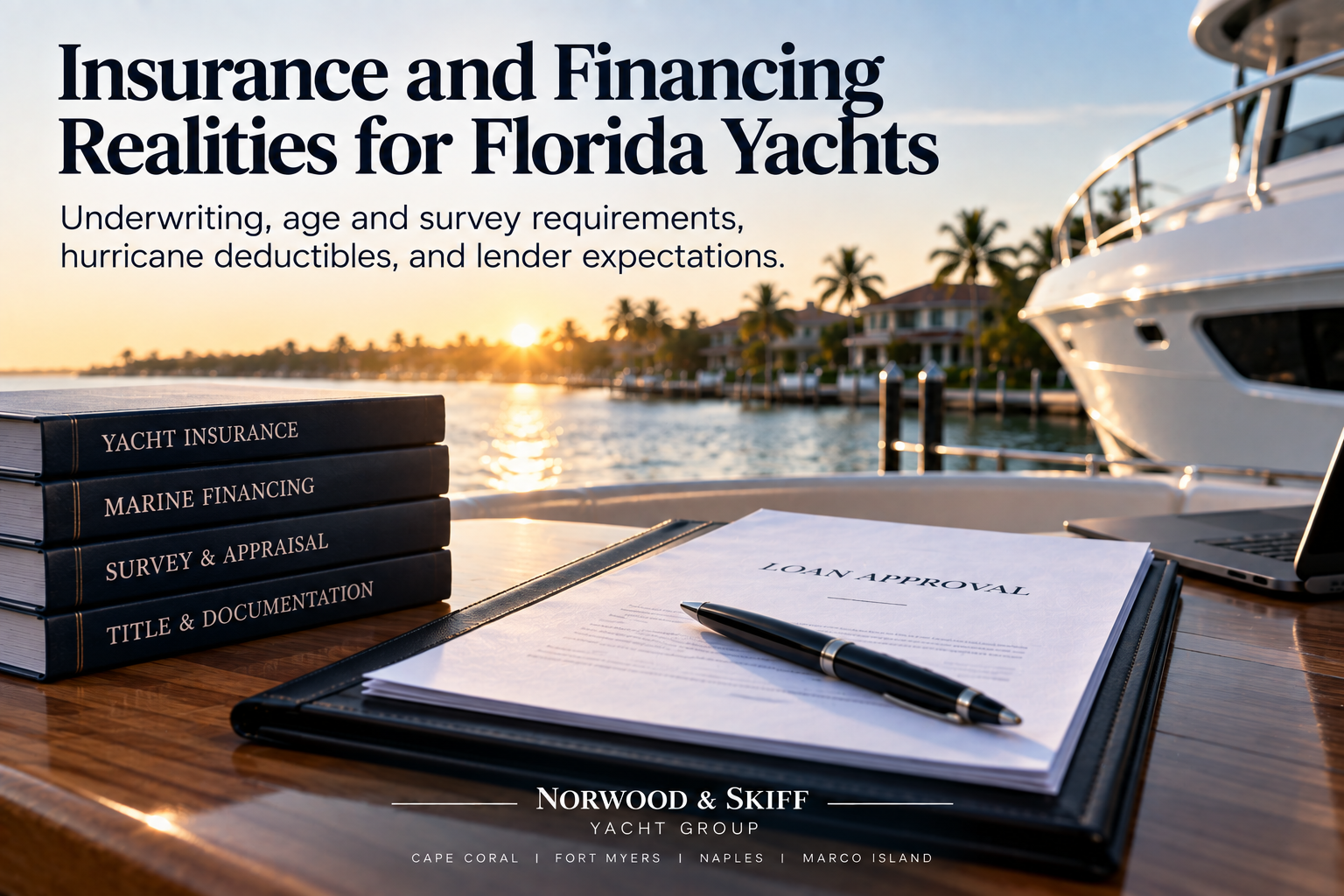
Insurance and Financing Realities for Florida Yachts
Practical guidance for Southwest Florida buyers and sellers
Insurance and financing can make or break a yacht transaction in Florida—especially for vessels over 36 feet and more than 15–20 years old. Underwriters and lenders have become significantly stricter after multiple storm seasons and rising claims costs. The result: deals that look solid on paper can fall apart late in the process when an insurer or bank says “no” or “not without conditions.”
For buyers and sellers in Cape Coral, Fort Myers, Naples, Marco Island, Punta Gorda, Sanibel, Captiva, Pine Island, Charlotte Harbor, and surrounding markets, planning ahead is critical.
Norwood & Skiff’s approach is simple: structure each deal so that insurance, surveys, and financing are addressed early, with records and risk controls ready before they’re requested.
How yacht underwriters actually look at your vessel
A yacht underwriter is the insurance company’s risk analyst. Their job is to decide:
- Will we insure this yacht at all?
- Under what conditions and limits?
- At what premium and deductible?
For Florida powerboats and motor yachts, underwriters focus on:
- Age and size of the yacht – Older yachts and vessels above 40–50 feet get more scrutiny.
- Construction and systems – Hull material, engines, pods, stabilizers, fuel systems, and electrical.
- Location and hurricane exposure – A boat that lives year‑round in Cape Coral or Fort Myers carries different risk than one stored inland or hauled for hurricane season.
- Use and cruising plans – Local day boating, Bahamas, Keys, offshore runs, or Great Loop all change the risk profile.
- Owner experience – Logbook of previous ownership, captain’s license, and actual operating time on similar vessels.
- Condition and maintenance – Documented maintenance, recent service, upgrades, and survey findings.
If a yacht appears “high risk”—older age, poor records, questionable storm plan—the answer is often either “no” or “we’ll write it, but with very high premiums and deductibles.”
Age, surveys, and why “insured last year” doesn’t mean “insurable now”
For Florida yachts, a current survey is rarely optional once the yacht reaches a certain age. An insurance survey is a written technical evaluation by a qualified marine surveyor that documents condition, deficiencies, and an opinion of value.
Common age‑ and survey‑driven realities:
-
15–20 years old and up:
Many insurers require a current survey (often within 12–24 months) before binding or renewing coverage. -
Workboats vs. pleasure yachts:
Older yachts in private use can still be insurable—if survey findings are addressed and documented. -
Survey recommendations:
Underwriters will often make coverage conditional on correcting certain items (for example, outdated hoses, corroded bonding, expired fire systems, or non‑compliant fuel lines).
For buyers, this means:
- Do not assume you can simply “take over” the seller’s policy.
- Plan for an insurance‑oriented survey and time to handle mandatory corrections.
- Understand that serious survey findings can cause an insurer or lender to require repairs before closing.
For sellers, this means:
- An older yacht with obvious deferred maintenance will limit the buyer’s insurance options and financing terms.
- Proactive maintenance and documentation can be the difference between a smooth, insurable sale and a deal that fails after survey.
Hurricane deductibles, storm plans, and Florida‑specific requirements
In Southwest Florida, hurricane risk is central to underwriting. Insurers now routinely:
-
Apply separate hurricane or named‑storm deductibles
- Often a percentage of the insured value (e.g., 5–10%), not a flat dollar amount.
- A $500,000 yacht with a 5% hurricane deductible has a $25,000 storm deductible.
-
Require a written hurricane plan that may include:
- Hauling and blocking the yacht at a particular wind forecast or storm track.
- Moving from Cape Coral or Fort Myers canals to a designated hurricane hole or yard.
- Securing additional lines, chafe gear, and removing canvas/enclosures.
-
Restrict coverage while in the water during certain wind speeds or storm stages, unless specific yard or storage arrangements are in place.
Yacht buyers in our region should be prepared to discuss:
- Where the yacht will be berthed (Cape Coral canal, Fort Myers marina, private lift, storage yard, etc.).
- Available haul‑out options and timeframes in a named storm.
- Dockage details: piling height, line setup, power reliability, surge exposure, and bridge access.
A well‑thought‑out hurricane plan, backed by realistic local options, helps underwriters become more comfortable with your risk profile—and often leads to more competitive premiums.
What lenders look for on Florida yacht loans
Financing expectations have tightened alongside insurance.
Beyond credit and income, lenders focus on:
-
Insurability:
Many banks will not close unless coverage is bound with an acceptable insurer and limits. -
Survey and value:
- A marine survey supporting the purchase price or loan amount is commonly required.
- Significant structural, engine, or safety issues flagged by the survey can delay or derail loan approval.
-
Age and type of vessel:
- Some lenders will not finance above a certain age, or will require larger down payments on older yachts.
- Custom, heavily modified, or unusual yachts can be more difficult to finance.
-
Documentation and title clarity:
- Clean title, absence of undisclosed liens, and proper U.S. documentation or state registration.
An experienced buyer’s broker will anticipate these lender expectations and shape contract timelines—survey dates, acceptance deadlines, and closing targets—around what banks and insurers actually need.
How buyers can present themselves and the yacht to satisfy insurers and lenders
Buyers can reduce last‑minute surprises by preparing early:
-
Clarify intended use and cruising plans
Be specific: Cape Coral canal cruising, Sanibel/Capitiva weekends, Keys/Bahamas runs, or Great Loop. Insurers price risk according to use, not brochure descriptions. -
Demonstrate operating competence
- Prior ownership of similar‑size vessels.
- USCG license or formal training where applicable.
- Willingness to use a captain temporarily for a step‑up in size.
-
Choose the right surveyors and specialists
- Independent hull and systems surveyor, not selected by the seller or listing broker.
- Engine survey by a brand‑qualified technician for inboards, pods, or larger outboards.
- Willingness to address critical safety and integrity items promptly.
-
Organize insurance and financing early in the process
Do not wait for final acceptance to obtain quotes. A captain‑broker who knows the Southwest Florida insurance and lending environment can help you present realistic information and avoid over‑promising to underwriters.
How sellers can make their yacht easier to insure and finance
Sellers in Southwest Florida can materially improve deal certainty and net proceeds by presenting a yacht that insurers and lenders are comfortable with.
Key steps:
-
Compile complete maintenance and service records
- Engine, generator, pods, stabilizers, and major systems.
- Receipts for significant work and periodic services (cooling system, exhaust, batteries, electronics).
- Records of previous storm or damage repairs, with documentation of proper remediation.
-
Address obvious deferred maintenance before listing
- Degraded hoses, corroded through‑hulls, inoperative bilge pumps, non‑functioning navigation lights, and expired fire extinguishers will all appear on a survey.
- Correcting the most common “insurance survey items” in advance makes your yacht more attractive to both buyers and underwriters.
-
Clarify dockage and storm strategy
- If the yacht has a proven hurricane‑season history in Cape Coral, Fort Myers, or Naples, be prepared to explain how it has been secured and protected.
- If you haul out for storms, keep yard invoices as evidence of your practice.
-
Be realistic about valuation
- An asking price far above market evidence can create problems when survey‑supported value is reviewed by a lender.
- Objective comparable sales, condition, and equipment should support pricing.
A prepared seller with a well‑documented vessel reduces transaction friction and can often achieve better, cleaner offers from qualified buyers.
Why an experienced, technically minded broker matters
Insurance and financing are not “paperwork details.” In Southwest Florida, they are central to whether a transaction closes at all.
Norwood & Skiff approaches each deal with:
- Captain‑broker and technical experience to understand what underwriters, surveyors, and lenders will question.
- Market‑evidence valuation so pricing, surveys, and lender expectations align.
- Structured due diligence around surveys, sea trials, and records review, with contract timelines that account for insurance and bank requirements.
- Candid guidance on when a yacht’s risk profile or condition makes it a poor choice—even if that means walking away.
If you’re planning to buy or sell a yacht in Cape Coral, Fort Myers, Naples, Marco Island, Punta Gorda, or the surrounding Southwest Florida markets, Norwood & Skiff can help you navigate the insurance and financing realities before they become problems.
Contact Norwood & Skiff Yacht Group to discuss your next yacht transaction, and put experienced judgment on your side from the first conversation through closing.