We can't find the internet
Attempting to reconnect
Something went wrong!
Hang in there while we get back on track

Experienced Boaters
Make Better Brokers.
Call us today and see for yourself.

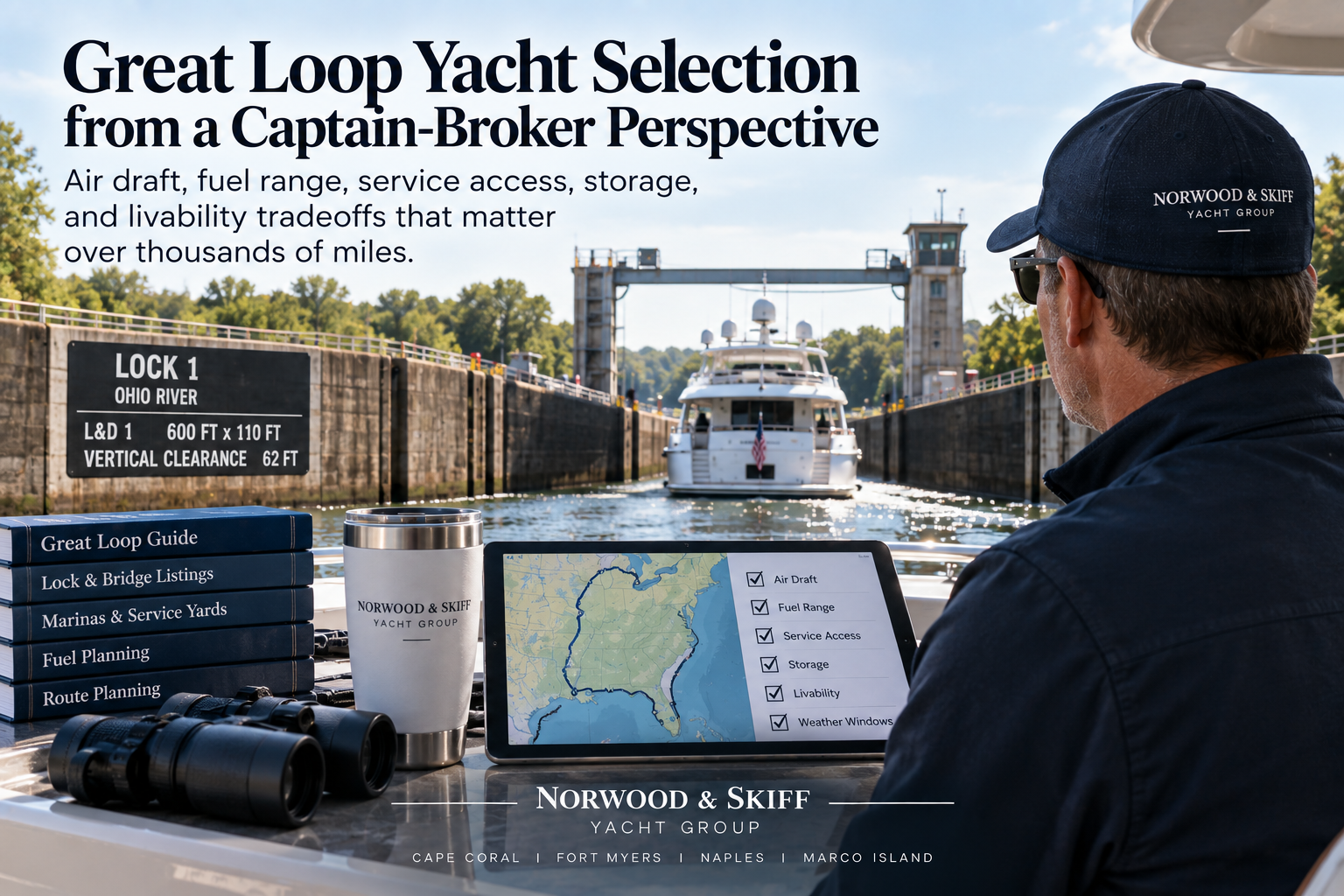
Choosing a Great Loop Yacht: A Captain‑Broker’s View for 36–60 Foot Motor Yachts
Running the Great Loop is a 6,000+ mile systems test on you and your yacht. Over that distance, air draft, fuel range, service access, storage, and livability are not preferences—they are risk and fatigue multipliers.
From a captain‑broker perspective, the right Great Loop yacht in the 36–60 foot range is the one that:
- Fits the route with margin (air draft, draft, fuel range)
- Can be maintained underway without drama
- Keeps a couple functional and rested over months, not weekends
- Still has strong resale appeal after the Loop
Below are the tradeoffs that matter most and how we talk through them with serious Loop clients at Norwood & Skiff.
Air Draft: Clearing Bridges With Margin, Not Optimism
Air draft is your height above the waterline—top of mast, antennas, or arch. For the Great Loop, it’s the first hard filter.
- The published limiting bridge is roughly 19’ 6” on the Illinois Waterway at normal pool.
- In practice, wise Loopers target 17’–18’ or less to maintain margin for water-level variability and error.
What to Look For
For 36–60 foot motor yachts, focus on:
- Lower stations with good visibility so you can run from below when you need the extra clearance.
- Folding arches / masts / bimini frames that can be reasonably lowered by a couple.
- Removable antennas, radar arrays, and light bars on quick disconnects.
- Documented “loop configuration” air draft (measured, not guessed).
Red Flags
- Tower structures, hard‑mounted domes, or fixed arches that cannot be folded without a yard.
- A “brochure” air draft that does not match reality once you add davits, tender, antennas, or solar.
From a resale standpoint, a properly set‑up “Great Loop capable” air draft is a strong selling point for the next owner.
Fuel Range: Realistic Range, Not Brochure Numbers
You do not need a trawler with transoceanic range for the Loop. You do need predictable, conservative range at the speeds you will actually run.
Practical Targets for Couples
For most 36–60 foot motor yachts:
- Slow cruise (7–9 knots): A safe range of 300–400 nautical miles between fills is usually more than adequate.
- Planing yachts: Many couples settle into a semi‑displacement / hull‑speed regime for economy, with the ability to speed up when conditions demand.
What Matters More Than Tank Size
- Known burn rates at real speeds. Sea trial data and manufacturer assumptions often differ from reality. We favor actual owner logs and surveyor‑measured fuel capacities.
- Fuel system access. Cleanable tanks, accessible fuel filters, and workable manifolds reduce the risk of contamination problems in remote areas.
- Generator fuel usage. Long days on the hook mean your generator is part of the fuel equation.
A boat with moderate tanks and honest, documented fuel burn can be safer than a “big‑tank” yacht with unknown consumption, dirty tanks, or inaccessible filters.
Service Access: The Difference Between an Inconvenience and a Trip‑Ender
On the Loop, you will be away from your home yard for months. Service access is a risk‑management decision.
Engine Room and Systems Access
For a couple cruising 36–60 feet, we look for:
-
Stand‑up or at least crouch‑able engine rooms with clear access to:
- Outboard sides of both engines
- Belts, raw‑water pumps, strainers, filters
- Shaft seals, steering gear, batteries, and breakers
- Accessible generator with space to change belts and impellers without disassembling cabinetry.
- Logical wiring and labeled circuits.
Why It Matters
- You will need to clean strainers, change filters, and address minor issues underway.
- A cramped installation can turn a 30‑minute task into a full‑day problem—or require a yard when none is available.
From a resale perspective, boats known for “service‑friendly” systems are easier to sell, especially to buyers planning serious cruising.
Storage: Long‑Range Cruising, Not Weekend Packing
Great Loop cruising is essentially small‑apartment living on a moving platform.
Storage Priorities for Looping Couples
We evaluate:
-
Dry, ventilated storage for:
- Spare filters, belts, impellers, hoses, and fluids
- Lines, fenders, cleaning gear, and safety equipment
-
Practical galley storage, including:
- Space for bulk dry goods and beverages
- Freezer capacity if you plan to anchor frequently
-
Deck and tender storage:
- Is there a safe, repeatable system for launching/retrieving the dinghy?
- Are fenders and lines quickly accessible near lock and dock stations?
Many production motor yachts were designed for weekend or short‑hop use, not months aboard. We pay close attention to how a couple will realistically live and stow gear day‑to‑day.
Livability: Reducing Fatigue Over Thousands of Miles
A yacht can be technically capable of the Loop and still be a poor fit for human endurance.
Layout and Traffic Flow
Key liveaboard features for couples:
- Separate sleeping and living zones so one partner can rest while the other is up.
- Safe, wide side decks with handholds where you actually need them—locks and tight docks are frequent.
- Stairs over ladders where possible. Repeated climbs with groceries, laundry, or lines add up.
-
Usable helm ergonomics:
- Good sightlines forward, aft, and to the sides
- Engine controls and thrusters reachable without awkward stretching
- Room for modern electronics and paper charts if you use them
Comfort at Anchor and Dock
- Ventilation and climate control. In Florida and the Southeast, reliable air conditioning and capable generators are not optional. So is shade on the flybridge and cockpit.
- Noise and vibration management. Hours of drone at certain RPMs are exhausting. We look for hull/prop configurations and insulation that keep sound levels tolerable.
A layout that feels “fine for weekends” can become frustrating on day 40. That frustration affects safety, decision‑making, and ultimately resale.
Tradeoffs That Affect Resale After the Loop
Most Great Loop buyers are thinking ahead: “What happens when we’re done?”
Features that tend to improve resale value in the 36–60 foot range:
- Documented Great Loop‑capable air draft, with photos and measurements.
- Thorough maintenance records—engines, generator, and key systems—showing service throughout the Loop.
- Practical layout for a couple or small family, not an extreme niche design.
- Recognized brands and models with established support networks (parts and service) in Florida and beyond.
-
Sensible equipment choices, such as:
- Updated navigation electronics
- Reliable bow (and possibly stern) thrusters
- Modern charging systems and inverter capacity
- Serviceable dinghy and davit solution
On the other hand, heavily customized interior changes, oversized permanent towers, or unusual mechanical conversions can narrow your buyer pool and reduce risk‑adjusted value.
Why a Captain‑Broker Perspective Matters
A Great Loop yacht is not just a “nice boat.” It’s:
- Machinery to understand and maintain
- An operating platform you’ll live on for months
- A transaction you will exit when you sell
An experienced captain‑broker looks beyond the listing:
- Does this specific hull make sense for how you actually plan to run it?
- Can you access what you’ll need to service on the Loop?
- Is the price supported by market evidence, condition, and documented maintenance?
- Is this a yacht we would recommend—or one where we’d advise you to walk away?
At Norwood & Skiff Yacht Group, our brokers combine captain‑level operating experience, technical judgment, and thousands of transactions to help Southwest Florida buyers choose the right Great Loop yacht—and exit it intelligently when the trip is complete.
Considering the Great Loop from Southwest Florida?
Talk with a Norwood & Skiff captain‑broker about air draft, range, service access, and realistic ownership costs for your specific plans. Contact our Cape Coral–based team to discuss which 36–60 foot motor yachts truly fit the Loop—and which do not.