We can't find the internet
Attempting to reconnect
Something went wrong!
Hang in there while we get back on track

Experienced Boaters
Make Better Brokers.
Call us today and see for yourself.

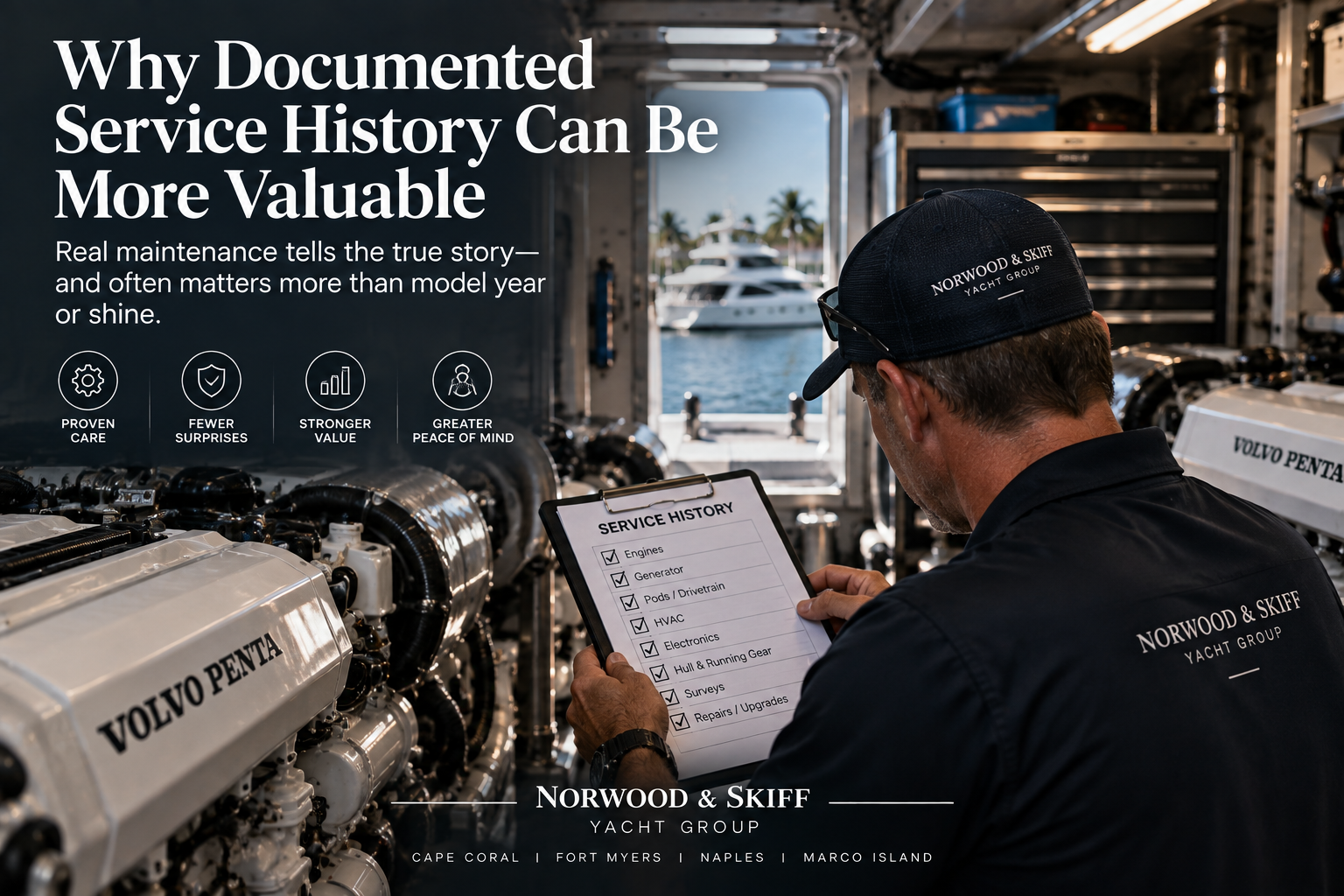
Why Documented Service History Can Matter More Than Model Year Or Shine
When you compare two similar yachts for sale—same brand, similar size, similar asking price—the natural instinct is to favor the newer, shinier boat.
In practice, that can be the wrong move.
For many buyers, especially in Southwest Florida, a yacht with complete, verifiable service history is often a safer, higher-value purchase than a newer model with thin or missing records. At Norwood & Skiff Yacht Group, we see this reality repeatedly: the “prettier” boat is not always the better boat.
This article explains why documented maintenance and service history deserves priority in your yacht search, and how it can turn the older boat into the smarter buy.
What “Documented Service History” Really Means
Before it can be evaluated, service history needs to be defined.
By documented service history, we mean:
- Dated invoices and work orders from recognized yards, technicians, or dealers
- Engine and generator service records (oil, filters, impellers, coolers, belts, valves, aftercoolers, pod or drive service)
- Systems maintenance (air conditioning, watermakers, stabilizers, thrusters, electronics, steering, hydraulics)
- Bottom and running-gear records (bottom paint, prop service, cutlass bearings, shaft seals, pod service)
- Upgrades and refits with part numbers, manuals, and installation documentation
- Hurricane or storm repairs, clearly identified and professionally documented
Verbal assurances—“the owner takes great care of it”—are not service history. Market value is supported by evidence, not anecdotes.
Why Records Can Outweigh Model Year
A newer yacht without documentation asks you to accept risk you cannot fully see. An older yacht with thorough records lets you evaluate condition and ownership costs with more confidence.
Key reasons:
1. You Can Verify Correct Parts And Procedures
Modern engines, pods, stabilizers, and electronics are sensitive to:
- Correct fluids and filters
- Manufacturer-recommended intervals
- Proper calibration and software updates
A detailed invoice trail shows:
- Which parts were used (OEM vs. generic)
- Who performed the work (dealer, certified tech, yard, owner)
- Whether services match manufacturer requirements
When those items line up, you are not just buying hours and cosmetics—you are buying evidence that the machinery has been cared for correctly.
2. You Reduce The Risk Of Expensive Surprises
In Florida’s heat, humidity, and saltwater, deferred maintenance becomes expensive quickly.
Common Southwest Florida risk areas include:
- Heat exchangers and aftercoolers corroding internally
- Air conditioning systems struggling from neglected seawater circuits
- Pods and drives suffering from skipped gear oil changes or seal service
- Hurricane-related damage that was patched but not properly repaired
Service records help answer, “What might this listing not reveal?” They support your survey and sea-trial strategy and reduce the chance of the “cheap” boat becoming the most expensive one to own.
3. You Get A Clearer Picture Of Ownership Costs
Every serious buyer wants to know: what will ownership actually cost?
Good records allow realistic budgeting:
- Upcoming major engine intervals
- Generator overhauls or replacements that are approaching
- Air conditioning, electronics, and battery bank timelines
- Canvas, upholstery, and soft-goods refresh cycles
- Bottom paint and running-gear work frequency
On an older yacht with strong documentation, you can often see which big-ticket items have already been addressed. That can be more valuable than a newer hull that is approaching its first major service with no records to rely on.
4. The Survey And Sea Trial Become More Meaningful
A survey is a professional technical inspection; a sea trial evaluates how the yacht runs underway. Both are more effective when supported by records.
With a documented history, your surveyor and buyer’s broker can:
- Focus on known weak points for that engine or system
- Compare current findings against past repairs
- Identify patterns of recurring problems vs. one-off issues
- Distinguish between normal wear and neglected maintenance
On a newer yacht with little documentation, more of the evaluation is guesswork—and that uncertainty has real financial consequences.
Why An Older, Well-Documented Yacht Can Be The Better Buy
Consider two similar Southwest Florida listings:
- Boat A: 2018 model, looks clean, limited documentation, owner says “everything has been done.”
- Boat B: 2012 model, high-quality yard and dealer service records going back years, recent engine cooling-system service, updated electronics, regular bottom work in Cape Coral and Fort Myers yards.
All else equal, Boat B likely offers:
- Lower mechanical risk (you can see what has been done and when)
- Better insight into true market value (condition and history support price)
- More predictable ownership costs over the first 2–3 years
- Stronger footing if you later sell to a buyer who also values documentation
The right decision is not always to buy the newest hull. It is to buy the yacht whose condition, history, and price make sense together.
How Service History Affects Resale Value
When you become the seller, documentation still matters.
A well-documented yacht is easier for a professional yacht broker to:
- Position against competing inventory
- Justify pricing with market evidence
- Present credibly to qualified buyers and their surveyors
- Keep together through survey renegotiations and closing
Sellers who maintain a complete paper (and digital) trail often net more realistic offers faster, because buyers can see and trust what they are getting.
What Buyers Should Ask For
When evaluating a yacht for sale in Cape Coral, Fort Myers, Naples, Marco Island, Punta Gorda, or nearby markets, your buyer’s broker should be asking for:
- Engine and generator service records (hours and dates, not just “serviced”)
- Invoices for any major repairs or refits
- Air conditioning and systems service records
- Bottom paint and running-gear service history
- Any hurricane, storm, or insurance claim documentation
- A written summary of known issues from the owner or manager
If records are missing, that does not automatically kill the deal—but it should affect price, survey scope, and risk tolerance. Sometimes the right professional advice is to walk away.
Why Independent Buyer Representation Matters
Listing brokers represent the seller. Their obligation is to market the yacht, not to audit its history for you.
An experienced buyer’s yacht broker with real operating and technical background will:
- Prioritize service history, condition, and risk-adjusted value, not just shine
- Help you interpret records in the context of model-specific issues
- Use comparable sales and market evidence to shape your offer
- Structure contracts, survey, and sea trial protections around what the records do—and do not—show
- Tell you when the older, better-documented yacht is the smarter move
- Tell you, candidly, when not to complete a transaction
This is where captain-broker and technical experience matter more than salesmanship. The hard part of brokerage begins where the listing ends.
Buying Or Selling In Southwest Florida? Start With A Conversation.
If you’re comparing yachts for sale in Cape Coral, Fort Myers, Naples, Marco Island, Punta Gorda, Sanibel, Captiva, Pine Island, or Charlotte Harbor, service history should be central to your decision—not an afterthought.
Norwood & Skiff Yacht Group helps buyers and sellers evaluate yachts based on documented maintenance, real condition, market evidence, and total ownership cost, not just model year or shine.
To discuss a specific listing, review service records, or plan a sale strategy for your yacht, contact Norwood & Skiff to speak directly with an experienced broker-captain.