We can't find the internet
Attempting to reconnect
Something went wrong!
Hang in there while we get back on track
Experienced Boaters
Make Better Brokers.
Call us today and see for yourself.

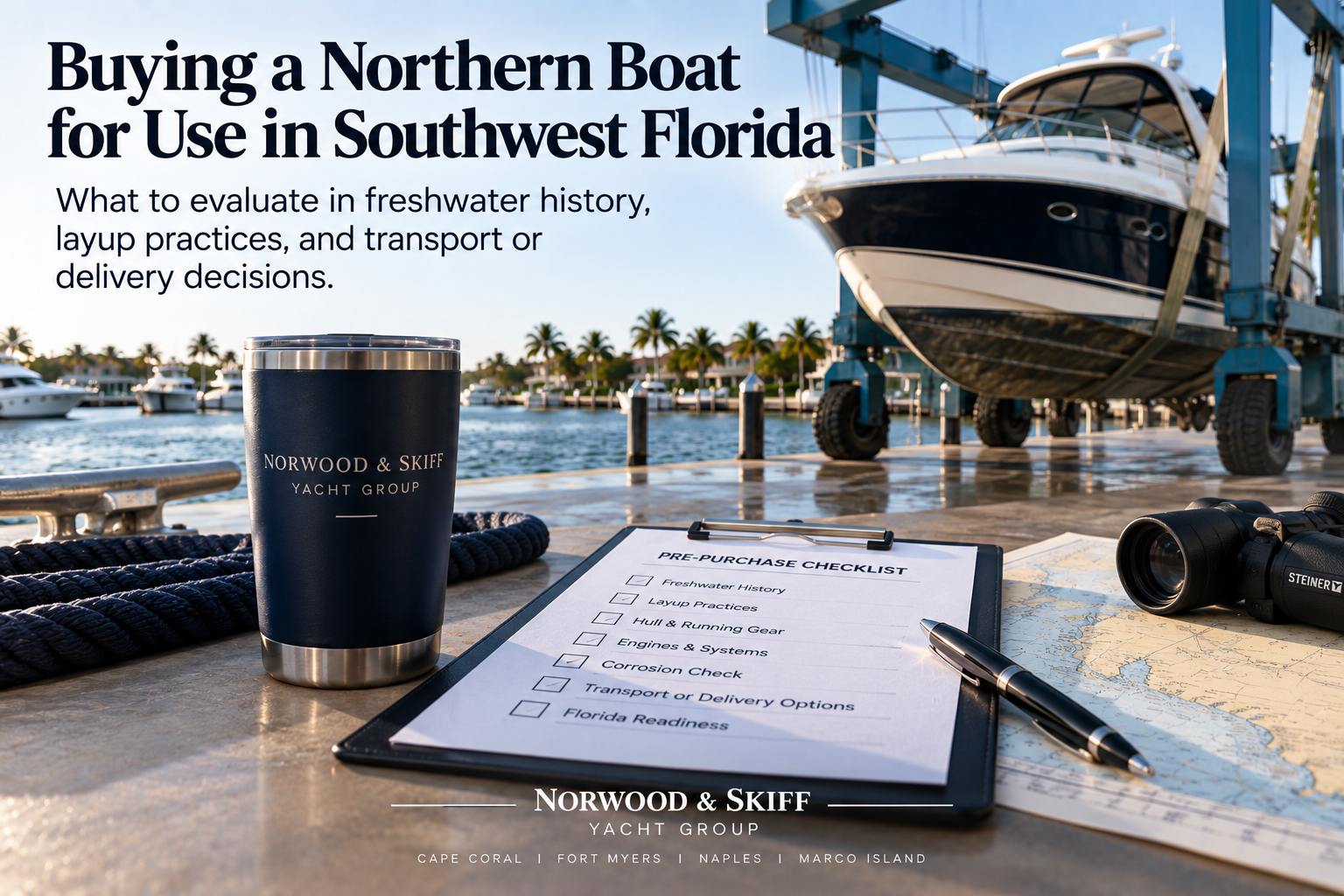
Buying a Northern Boat for Use in Southwest Florida: What Really Matters
Many Southwest Florida buyers look at Great Lakes and other “northern” boats as attractive options: cleaner freshwater history, shorter seasons, and often less visible cosmetic wear. Those can be real advantages—but only if you understand what it takes to bring a northern boat into year‑round, warm‑salt operation around Cape Coral, Fort Myers, Naples, Marco Island, Punta Gorda, Sanibel, Captiva, Pine Island, and Charlotte Harbor.
A northern boat can be a smart purchase or an expensive learning experience. The difference comes down to due diligence, survey focus, and realistic valuation.
At Norwood & Skiff Yacht Group, we evaluate northern boats through four main lenses:
- Freshwater vs. saltwater history
- Layup and storage practices
- Transport or delivery strategy
- Reconditioning for Southwest Florida systems and conditions
Below is how we recommend thinking about each of these before you make an offer.
1. Freshwater History: Benefits and Blind Spots
“Freshwater boat” sounds great, and it often is—but the label alone doesn’t guarantee value.
Potential advantages of freshwater history
When properly documented, freshwater use can mean:
- Less external corrosion on metals and hardware
- Cleaner bilges and machinery spaces
- Reduced salt‑related wear on systems and fittings
- Less UV damage if the boat has been stored indoors or under cover part of the year
These can translate into lower immediate reconditioning costs and a nicer starting point for a Southwest Florida yacht.
What to verify about freshwater claims
Before you pay a premium for freshwater history, your buyer’s broker and surveyor should verify:
- Actual operating area: Was the boat truly used only on inland lakes or rivers, or did it spend time in brackish or saltwater?
- Time in the water per season: Northern boats may sit in the water continuously for the season or be trailered and dry‑stored—each has different implications for bottom condition.
- Marina water and power: Older marinas, marginal shore power, or poor ground systems can still cause corrosion and electrical issues in freshwater.
- Engine cooling configuration: Were the engines and generators fully fresh‑water cooled with heat exchangers, or is some part of the cooling raw water–cooled and more vulnerable to corrosion once moved to saltwater?
A well‑documented freshwater boat with strong maintenance records can justify paying more than a comparable saltwater boat. A “freshwater” boat with thin documentation or questionable history should be priced accordingly.
2. Layup Practices: Off‑Season Storage Really Matters
Northern boats typically spend several months a year “laid up” for winter. How that layup was done will directly affect your ownership experience once the boat arrives in Southwest Florida.
Key layup questions
Ask for detailed information and records on:
-
Winterization procedures:
- Was the fresh water system correctly winterized?
- Were engines and generators properly protected?
- Were air conditioning systems and pumps winterized or left dry?
-
Storage environment:
- Heated indoor storage, cold indoor storage, or outdoor shrink‑wrap?
- Evidence of moisture issues, mold, or deck leaks during storage?
-
Batteries and electrical:
- Were batteries maintained on smart chargers or simply disconnected and left?
- Any history of frozen or replaced batteries due to winter damage?
-
Frequency of commissioning/decommissioning:
- Repeated improper layup and recommissioning can create recurring leaks, failed hoses, and electrical gremlins.
On survey, your team should pay particular attention to:
- Hoses, clamps, and seacocks that may have been stressed by repeated freeze/thaw cycles
- Sanitation systems (a common source of winterization failures)
- Deck, windows, and hatches for evidence of long‑term seepage while stored
A history of professional layup with invoices and checklists is a meaningful plus.
3. Transport vs. Delivery: Getting a Northern Boat to Southwest Florida
Once you find the right northern boat, you have two main options: over‑the‑road transport or delivery by water.
Over‑the‑road transport considerations
Over‑the‑road can be the best choice when:
- Air draft or bridge clearance limit a safe or efficient delivery route
- The boat isn’t yet ready for a long coastal passage
- You want controlled timing and less wear on engines and systems
However, over‑the‑road requires:
- Haul‑out, bottom inspection, and preparation (removing arch/hardtop or electronics in some cases)
- Cradle or blocking, shrink‑wrap, and permits
- Re-commissioning on arrival in Florida (reinstalling removed components, sea‑trialing, bottom inspection)
Your survey and buyer representation should address structural support points and how the hull will be blocked and transported to avoid damage.
Professional delivery by water
A properly crewed delivery can be beneficial:
- Systems are used and tested under real operating conditions
- Any marginal components often reveal themselves before you take full possession in Southwest Florida
- The captain can prepare a condition and punch‑list report
But you must factor:
- Weather windows and routing
- Insurance requirements for long deliveries
- Additional running hours on engines and generators
For some buyers, a combination approach (partial over‑the‑road, partial water delivery) makes the most sense. An experienced captain‑broker can help you choose the right method and budget accordingly.
4. Reconditioning for Warm-Salt Operation
Once the boat arrives in Cape Coral or nearby Southwest Florida waters, the real transition begins.
Bottom systems and antifouling
Northern freshwater bottom paint is usually not adequate for year‑round Gulf Coast fouling pressure. For Southwest Florida use, you should typically plan for:
- Stripping or sanding back old, incompatible paint if necessary
- Applying appropriate multi‑season antifouling for warm saltwater
-
Inspecting and likely updating:
- Shaft seals
- Struts and cutless bearings
- Trim tabs and their fasteners
- Thru‑hulls and seacocks
- Transducers and grounding plates
If the boat lived on a lift up north, there may be minimal bottom history—but you’ll still need a bottom system suitable for local canal, river, or marina storage.
Corrosion protection and zincs
Going from freshwater to saltwater changes the corrosion environment:
- All sacrificial anodes (zincs) should be evaluated and likely replaced with the correct spec for saltwater
- Bonding systems and shore power connections should be tested and confirmed
- Thrusters, pods, and stabilizers may require additional anode protection once in Florida
Your survey and pre‑purchase planning should include a corrosion and bonding review, not just a visual check of zincs.
Air conditioning and electrical loads
A boat that ran its air conditioning a few weekends a year up north will be worked much harder in Southwest Florida.
Expect to evaluate:
- Chilled‑water or direct‑expansion (DX) systems for capacity in high heat and humidity
- Raw water AC pumps and strainers, which will deal with year‑round warm, fouling‑prone water
- Shore power capacity and main breaker sizing relative to continuous AC and house loads
- Insulation, window treatments, and sun exposure that impact interior temperatures
Upgrades may include higher‑capacity raw water pumps, additional AC units in key cabins, improved ventilation, or upgraded shore power connections.
5. How These Factors Affect Value, Offers, and Survey Focus
When comparing a northern boat to a local Southwest Florida yacht, you should think in terms of risk‑adjusted value, not just asking price.
A northern boat may justify a premium if:
- Freshwater history is well documented
- Layup practices were professional and consistent
- Transport is planned and budgeted correctly
- You’ve accounted for reconditioning costs to make it truly Florida‑ready
Conversely, even a glossy freshwater boat should be discounted if:
- Maintenance and service records are sparse
- Winterization history is unclear
- Survey reveals marginal systems that will be stressed by year‑round Florida use
- Bottom, AC, and corrosion protection all need immediate attention
Your offer strategy should be built around:
- Recent comparable sales with similar history (freshwater vs saltwater, geography, brand, and condition)
- A realistic estimate of required upgrades for warm‑salt operation
- Clear contract protections around survey, sea trial, and transport findings
An experienced buyer’s yacht broker should help you structure a contract where your deposit is protected if the survey, transport inspection, or reconditioning estimates uncover issues that materially change the value proposition.
Local vs. Northern: Which Is Right for You?
There is no single right answer. Some of the best purchases in Southwest Florida start as carefully chosen northern boats. Others are local yachts with known histories, already set up for Cape Coral canals, bridge clearances, and year‑round saltwater service.
The key is disciplined evaluation:
- Buy the right yacht for how you actually intend to use it
- Let market evidence, documented maintenance, and condition drive valuation
- Factor in the real costs of reconditioning for Southwest Florida
- Use the survey and sea trial to test assumptions—not to justify a decision already made
If you’re considering a northern yacht for use in Southwest Florida—or comparing it to a local option—Norwood & Skiff’s captain‑brokers can walk you through the technical, financial, and logistical tradeoffs before you commit.
Contact Norwood & Skiff Yacht Group to discuss your plans and have an experienced broker evaluate your options, survey strategy, and true risk‑adjusted value.